
Introduction
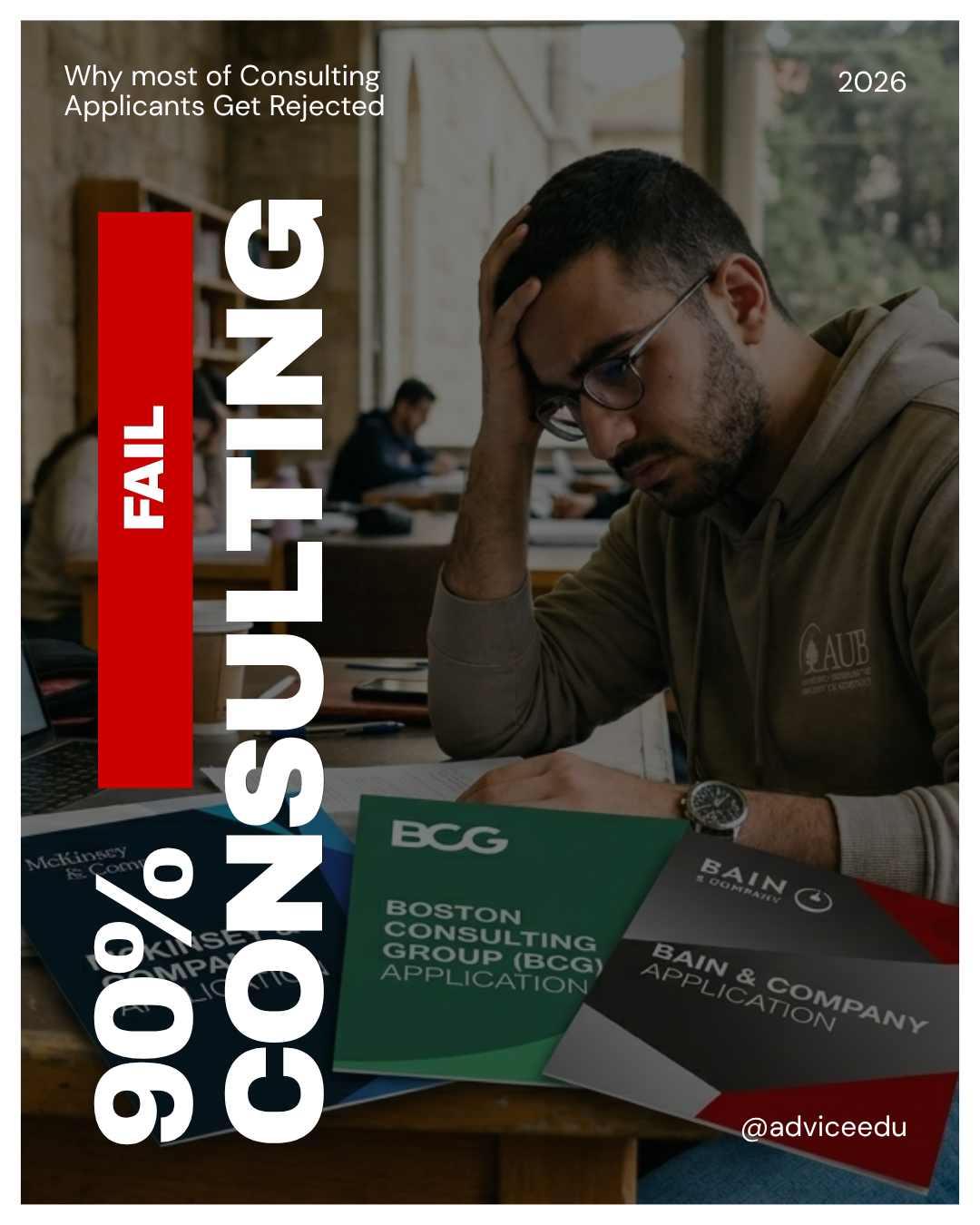
Every year, thousands of students and graduates dream of securing an offer from top consulting firms such as McKinsey & Company, Boston Consulting Group (BCG), Bain & Company, Strategy&, Kearney, Oliver Wyman, and Roland Berger.
Many of these candidates have excellent GPAs, leadership positions, internship experience, and strong extracurricular profiles. Yet despite impressive credentials, the majority fail during the interview process.
The reason is not a lack of intelligence.
In fact, most candidates who fail consulting interviews are academically capable. They simply misunderstand what consulting firms are actually evaluating.
Case interviews remain one of the most challenging recruitment assessments in any industry. They require a unique combination of analytical thinking, business judgment, communication skills, numerical reasoning, and structured problem-solving.
Understanding why candidates fail is often the first step toward success.
This guide explains the most common mistakes consulting candidates make and provides practical strategies to avoid them.
10,000 Consulting Cases
— Try Consulting GPT, designed for Middle East Consulting Interviews
What Is a Case Interview?
A case interview is a simulation of a real business problem.
Instead of asking traditional interview questions, the interviewer presents a scenario that a consultant might face with a client.
Examples include:
- A company’s profits are declining.
- A retailer wants to expand internationally.
- A government is evaluating a major investment.
- An airline is losing market share.
- A technology company is considering an acquisition.
The candidate must analyze the situation, ask relevant questions, interpret data, perform calculations, and ultimately recommend a course of action.
Unlike university exams, there is rarely a single correct answer.
Interviewers are primarily interested in how candidates think.
Why Consulting Firms Use Case Interviews
Consultants solve complex problems every day.
Clients pay consulting firms millions of dollars not for information, but for insight and judgment.
As a result, firms need employees who can:
- Break down ambiguity
- Structure problems logically
- Analyze information quickly
- Communicate clearly
- Make decisions under pressure
Case interviews provide a realistic way to evaluate these capabilities.
For this reason, they remain a central part of recruitment across virtually every leading consulting firm.
Preparing for consulting interviews?
— Join our Consulting prep sessions
Mistake #1: Memorizing Frameworks Instead of Learning How to Think
Perhaps the most common mistake candidates make is treating case preparation as a memorization exercise.
Many students spend weeks memorizing profitability frameworks, market entry frameworks, merger frameworks, and countless other templates found online.
While frameworks can provide useful guidance, they are not substitutes for critical thinking.
Interviewers immediately recognize when candidates are forcing memorized structures onto problems that require a different approach.
Strong candidates do not rely on pre-packaged answers.
Instead, they build customized structures that reflect the unique characteristics of each case.
The goal is not to remember frameworks.
The goal is to understand business problems.
Mistake #2: Practicing Too Few Cases
Many candidates believe reading case books is sufficient preparation.
It is not.
Reading about swimming is not the same as swimming.
Similarly, reading about case interviews is not the same as solving them.
Case interviews require active practice.
Top candidates often complete dozens of live cases before their interviews.
Each practice session helps develop:
- Communication skills
- Problem structuring
- Mental math
- Business judgment
- Confidence
Candidates who practice only a handful of cases are typically unprepared for the pressure of real interviews.
Mistake #3: Ignoring Business Fundamentals
Consulting is fundamentally a business profession.
Yet many candidates approach interviews without a solid understanding of how businesses operate.
Interviewers expect candidates to understand concepts such as:
- Revenue
- Costs
- Profitability
- Market share
- Competitive advantage
- Customer behavior
- Pricing strategies
Without this foundation, even strong analytical thinkers struggle to develop meaningful recommendations.
Reading business news regularly can significantly improve performance.
Following developments in technology, healthcare, energy, finance, and consumer goods helps candidates build stronger commercial awareness.
Mistake #4: Weak Quantitative Skills
Many candidates underestimate the importance of numerical analysis.
Consultants frequently work with data.
Consequently, firms assess whether candidates can interpret numbers accurately and efficiently.
Common quantitative tasks include:
- Market sizing
- Growth calculations
- Break-even analysis
- Profitability calculations
- Revenue projections
Candidates do not need advanced mathematics.
However, they must perform calculations quickly and accurately without relying on calculators.
Mental math remains one of the most overlooked aspects of consulting preparation.
Mistake #5: Failing to Communicate Clearly
Consulting is often described as a communication business disguised as an analytical business.
The most brilliant analysis has little value if it cannot be communicated effectively.
Many candidates think silently for long periods during interviews.
Others jump directly into answers without explaining their reasoning.
Neither approach works.
Interviewers need visibility into the candidate’s thought process.
Strong candidates communicate continuously.
They explain:
- Their assumptions
- Their reasoning
- Their calculations
- Their conclusions
This allows interviewers to follow their logic and assess their problem-solving ability.
Mistake #6: Treating the Interview as an Examination
Traditional education often rewards finding the correct answer.
Consulting interviews are different.
Interviewers are not searching for perfect answers.
They are searching for strong thinking.
Candidates who become obsessed with finding the “right answer” often become stressed and inflexible.
The strongest candidates remain curious.
They ask thoughtful questions.
They test hypotheses.
They adapt their thinking when new information emerges.
This mirrors how consultants operate with real clients.
Mistake #7: Neglecting the Personal Experience Interview
Many candidates devote all their preparation time to cases and neglect behavioral interviews.
This is a major mistake.
At firms such as McKinsey, personal experience interviews carry significant weight.
Interviewers evaluate:
- Leadership
- Teamwork
- Resilience
- Conflict management
- Personal impact
Candidates should prepare detailed stories demonstrating these qualities.
Strong stories are specific, structured, and focused on measurable impact.
Generic responses rarely succeed.
What Top Candidates Do Differently
After observing thousands of consulting candidates worldwide, several patterns consistently emerge among successful applicants.
They Start Early
Top candidates rarely begin preparing a few weeks before interviews.
Many start months in advance.
This allows time for gradual improvement rather than last-minute cramming.
They Focus on Fundamentals
Rather than memorizing frameworks, successful candidates master:
- Problem solving
- Communication
- Business concepts
- Quantitative reasoning
These skills transfer across all case types.
They Seek Feedback
Practice without feedback has limited value.
Strong candidates actively seek constructive criticism.
They identify weaknesses early and address them systematically.
Continuous improvement becomes part of their preparation process.
They Develop Business Curiosity
Successful candidates are genuinely interested in business.
They regularly follow:
- Market trends
- Corporate strategy
- Industry developments
- Economic news
This knowledge improves both case performance and interview discussions.
How Many Cases Should You Practice?
There is no universal number.
However, most successful candidates complete between 30 and 70 live practice cases before interviewing.
The exact number matters less than the quality of practice.
A candidate who completes 40 cases with detailed feedback often performs better than someone who rushes through 100 cases without reflection.
The objective is deliberate practice, not volume alone.
A Practical Preparation Plan
Phase 1: Learn the Fundamentals
Duration: 2–3 weeks
Focus on:
- Consulting industry basics
- Business concepts
- Case interview structure
- Mental math
Phase 2: Structured Practice
Duration: 4–6 weeks
Focus on:
- Live case practice
- Market sizing
- Data interpretation
- Communication skills
Aim for multiple cases per week.
Phase 3: Advanced Refinement
Duration: 2–4 weeks
Focus on:
- Difficult cases
- Personal experience interviews
- Mock interviews
- Targeted improvement areas
At this stage, candidates should simulate real interview conditions as closely as possible.
Why Consulting Preparation Is Different in the Middle East
Candidates targeting consulting firms in the Middle East face unique opportunities.
The region continues to experience significant growth in:
- Public sector transformation
- Economic diversification
- Infrastructure development
- Technology adoption
- Sustainability initiatives
As a result, consulting firms continue to expand hiring across Saudi Arabia, the UAE, Qatar, and other regional markets.
However, competition has also increased dramatically.
Students from leading regional and international universities now compete for a limited number of highly selective positions.
Preparation has become more important than ever.
Final Thoughts
The belief that consulting interviews are impossible is one of the biggest myths in recruitment.
Most candidates who fail are not rejected because they lack intelligence.
They are rejected because they prepare inefficiently.
They memorize instead of thinking.
They read instead of practicing.
They focus on frameworks instead of fundamentals.
Consulting firms are looking for future problem-solvers, communicators, and leaders—not walking textbooks.
Candidates who develop structured thinking, strong communication skills, business judgment, and consistent practice habits place themselves in the strongest position to succeed.
The reality is simple: consulting interviews are difficult, but they are learnable.
Those who prepare strategically and persistently can dramatically improve their chances of securing offers from the world’s most prestigious consulting firms.
Leave a Reply